09 April, 2011

English Speaking club - World Health Day

The English Speaking club session at WOA Dnipropetrovsk started with the table display of the books on health from the Center’s  funds.

During the introduction Club members were telling about their attitude to health and health activities.
The most popular hobbies among the club members are soccer, lawn tennis, Callanetics, jogging, morning exercises, bicycle rides.

Ms.Tamara Gavryliuk presented a slide show about the World Health Day celebrated worldwide on April, 7.
The club members were informed about the World Health Organization’s focus in 2011 – “Combat drug resistance”.  The key messages  of 2011 – to keep one’s hands clean, not to overuse antimicrobials, not to self-administer medicines. The topics of the previous years were presented.

After the slide show the discussion continued and the following topics were introduced:
-        Occupational hazards in different professions;
-        Modern food hazards (genetically modified foods, antibiotics in the food chain, etc.);
-        The notion of a healthy lifestyle;
-        Our own healthy habits (morning exercises, outdoor activities,  proper timing of one’s life);
-        Professional sport and its hazards.

In the last part of the session new vocabulary was introduced by Tanya Volokita for the movie “Lost in translation”.

Number of the visitors 20  (the English language  teachers –1,  specialists – 12, retired 1, students – 4, pupils – 1, librarian –1)


05 April, 2011

02 April, 2011

English Speaking club - April Fools’ day


The ESC session took place at WOA Dnipropetrovsk, the participants had a chance to improve their English language skills and to learn more about the United States of America.
The new Club members were introduced to the regular members. One newcomer, an ex-participant of the “Work & Study” program, was asked to prepare a presentation  about her trip to the USA and share her impressions.
The topic of today’s session was “Celebration of the April Fools' Day in the USA”.
We have managed to:
- discuss the specific features of the American humor;
- compare the traditional practical jokes in USA and Ukraine;
- discuss the celebration of the Fool’s day in Odessa (Ukraine) the Ukrainian capital of humor;
- recollect the history of a popular American TV show “Candid Camera”;
            - discuss the phenomenon of sexist jokes;
            - share the ideas about the jokes of world known politicians.
We found out that everybody likes humor and good jokes. We dislike cruel pranks and jokes that hurt feelings of other people. Humor should be kind to be enjoyable!
After the discussion we watched a couple of related video clips (YouTube):
- the American movie celebrities on Candid Camera;
- President B.Obama’s speech at the White House dinner for Correspondents.

Tanya Volokita, a young WOA volunteer, was a speaker of the Club, she was a good moderator of the discussion and asked a lot of relevant questions.

The second half of the meeting – a special interest presentation by the University lecturer Tamara Gavruliuk. She presented the final part of the slide show “American Leisure”. More information was provided about the American food culture.

Number of the visitors 25  (the English language  teachers 5,  specialists – 8, retired 1,
students – 8, pupils – 2, librarian –1)

Global Security Summer Program for Students and Young Professionals

Apply: Global Security Summer Program for Students and Young Professionals in Slovakia and Uzhgorod (June 25-July 3)
Application deadline: May 1, 2011. If you are a Ukrainian Master`s Degree student or are working on your doktor nauk or kandidat nauk inPolitical Science and/or International Relations, or if you are a young professional interested and active in foreign and security policy issues, consider applying to the "Challenges of the Global Security Environment" summer program. You would join other students from Central and Southeastern Europe and South Caucasus in an interactive weeklong forum, from June 25 to July 3, in Slovakia and Uzhgorod focused on the current issues of the security policy. The Slovakian NGO Centre for European and North Atlantic Affairs (CENAA) is running the program with support from the NATO Public Diplomacy Division (PDD), the Ministry of Defense (MOD) of Slovakia, and the U.S. Embassy in Bratislava. If you are selected, your travel costs, accommodation and meals will be fully covered, although there will a participation fee of 60 euros and you will need to pay fees for the necessary visa, too. For more information, please go to:
http://cenaa.org/en/?page_id=494.

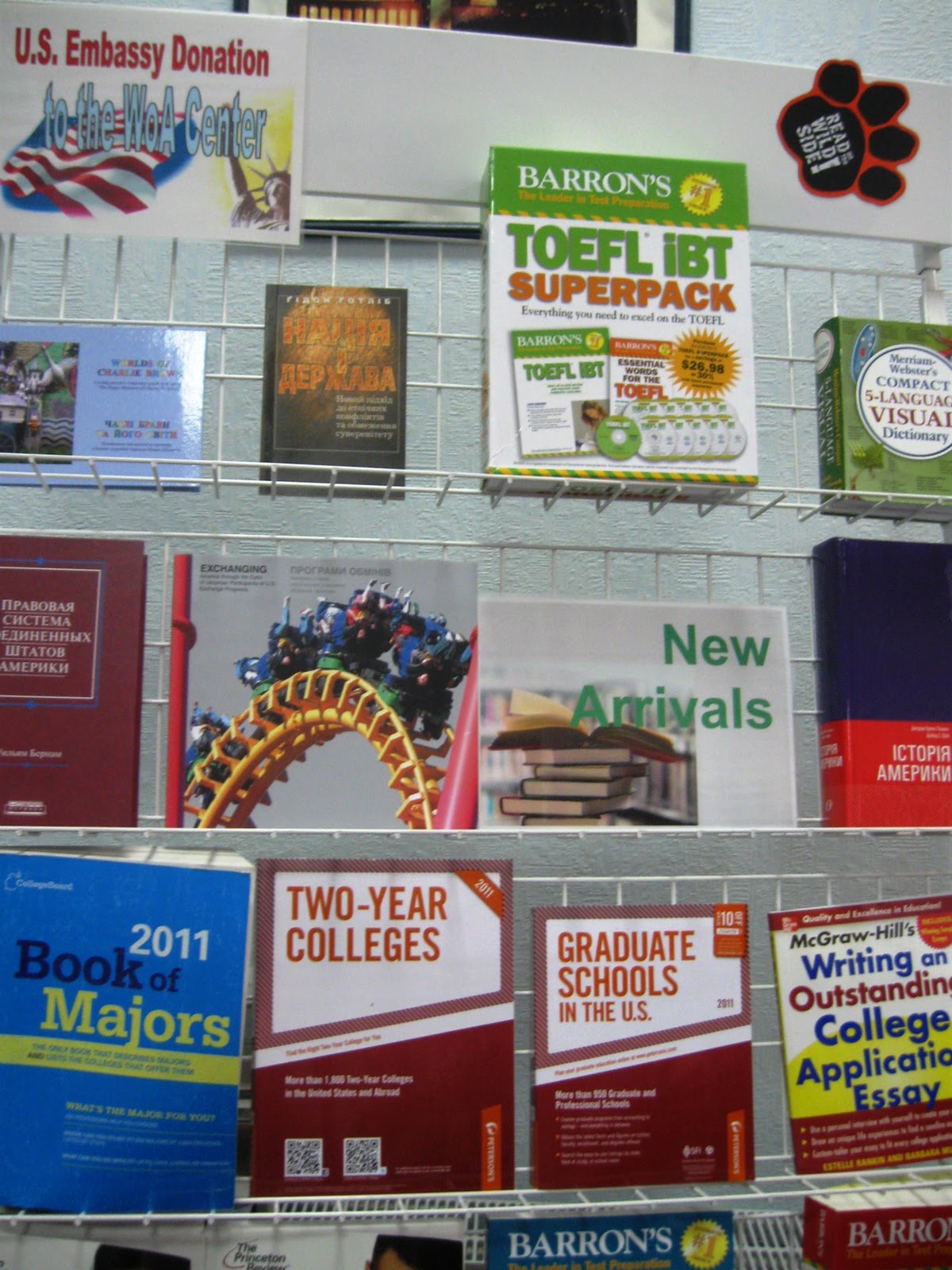
Book Display: «New Arrivals»


A display “NEW ARRIVALS” was presented at WOA Dnipropetrovsk. It included 30 new books and 13 CDs.
A part of the new arrivals – 7 books and 13 CDs – is a donation of the U.S. Embassy in Ukraine. The new books include:
- publications on the history of the USA;
- directories of the USA universities and colleges;
-  test preparation books (for TOEFL, GRE,GMAT, SAT).

            WOA’s loyal friend from the USA, Mr. Joseph Battilega, donated 13 fiction books. Mr. Battilega  reads a lot;  by donating  books  he promotes American authors  among the WOA readers.


Please, come to view the display and to check out some selections.
Great thanks to our donors!


31 March, 2011

English Humour vs. American Humor – Is There a Difference?

English Humour vs. American Humor – Is There a Difference?

Humour is a phenomenon which is influenced by culture. It can be difficult to determine what aspects define a certain sense of humour. A nation’s wit is linked to the historical development of the country. How funny somebody finds a certain incident depends on many factors including age, personal experience, level of education and geographical location. Therefore humour is something which is not always transferrable in another country. What somebody from one area may find hilarious may not be amusing at all to somebody from another location. Whether or not someone gets a joke is determined by their interpretation, filtered by the cultural context.

What about when both countries speak the same mother tongue? Does that mean that they will then share the same sense of humour, or can differences still occur? Let’s take the example of Britain and America. Time and time again, people say that Brits and Americans don’t ‘get’ each other’s sense of humour. To what extent is this true, if at all?

It is often argued that one of the most common differences between the British and American sense of humour is that Americans don’t understand irony. Simon Pegg explores this topic in depth in his article What are you laughing at? He concludes that this statement isn’t true and I am inclined to agree with him.

One of the major differences seems to be how often both nations use irony. Brits use irony on a daily basis, whereas it is not the foundation of American humour. I think Americans understand British irony (most of the time anyway!), what they don’t understand is the need to use it so frequently. When Americans use irony they tend to state that they were “only kidding”. They feel the need to make a joke more obvious than Brits do, maybe this stems from a fear of offending people.

The American sense of humour is generally more slapstick than that in Britain. I think this arises from a cultural difference between the two. Their jokes are more obvious and forward, a bit like Americans themselves. British jokes, on the other hand, tend to be more subtle but with a dark or sarcastic undertone. There is usually a hidden meaning. This may stem from the fact that British culture is more reserved than American culture.
Certain American comedies have gained huge success in Britain and vice versa. Therefore, although there are differences between both comic styles, there is still an appreciation and understanding of the other sense of humour. Both the British and America versions of the comedy The Office are hugely successful on both sides of the Atlantic. Both shows have their own cultural differences, yet they portray a lifestyle which both Americans and Brits alike can relate to.

Although both nations have subtle differences in their wit, they can both appreciate the other’s sense of humour. For some great insight into differences between American and British English check out separated by a common language, which served as inspiration for this article.


http://www.lexiophiles.com/english/engl ... difference